

From time to time, we witness course corrections from the world’s leading brands and businesses. Whether due to strategic decisions, adaptations to consumer lifestyles, or simply the pursuit of revenue and profitability growth, which don’t always go hand in hand.
We’ve previously discussed the importance of planning growth with a clear strategy, one that not only makes sense for the brand or business, but also addresses market demands and, above all, serves the consumer.
Growth driven solely by market share gains, without control, often leads to major strategic reversals that take a long time to fully recover from. It’s easier to chart a course for a transatlantic ship with a coherent route than to try and abruptly steer it. Sudden changes affect priorities, culture, people and take time to realign.
We focus our analysis on the industry where we’ve had deeper involvement: Footwear and Apparel, particularly within the sports segment.
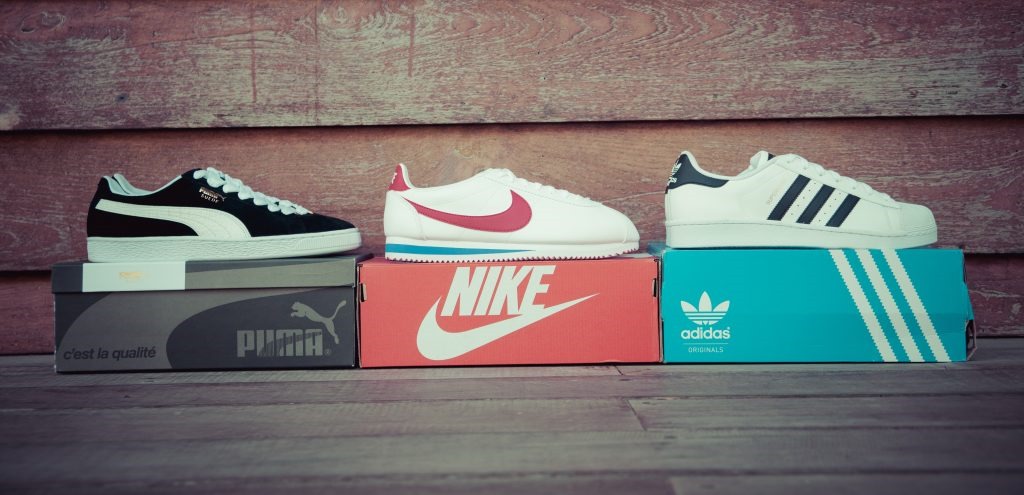
Take, for example, the three global giants in the sportswear market: Nike, Adidas and Puma. Over the past decade, each has gone through cycles of expansion, profitability-driven adjustments, and strategic overhauls. These are top-of-mind brands in the sports market, investing significant portions of their annual revenues to fuel consumer desire — through brand salience, innovation, connection with athletes and influencers, point-of-sale experiences, and activations in sports and cultural events.
However, all three have also experienced the so-called “accordion effect”: major resets and abrupt strategic shifts.
. Nike enjoyed the longest stretch of uninterrupted growth: from 2014 to 2023, doubling its size and reaching $51 billion in revenue, with net income above $5 billion. But in 2024, revenue plateaued and profit dropped to $3.2 billion, a clear warning sign. A strategy focused heavily on DTC, the deprioritization of wholesale, and a lack of relevant innovation led to bloated inventories and shrinking margins. The company had to invest heavily in inventory clearance and replace its CEO, returning to a focus on leading through innovation.
. Adidas faced similar turbulence for different reasons: a slowdown in China, exit from Russia, and, most notably, the end of its partnership with Kanye West and the Yeezy line, which had a significant sales share. This created a massive inventory backlog, only resolved the following year, resulting in a $700 million loss. In 2023, adidas began a repositioning under a new CEO, revived successful platforms (like the Samba), and reconnected with consumers through high-value collaborations, revitalizing both its performance and lifestyle categories. The result: strong growth in 2024 and double-digit acceleration in 2025, including a comeback in the all-important U.S. market.
Now, the pattern repeats with Puma. In 2024, it saw modest growth and declining profitability. In 2025, it launched a deeper reset: an extensive strategy review, channel restructuring, resource realignment, and portfolio overhaul, particularly due to overreliance on lifestyle. The year is expected to end with operational losses, high inventories, and squeezed margins. But with a key difference: Puma’s scale is far smaller than Nike’s or adidas’. Its market value has dropped 60% in 2025, and rumors of a potential sale have already emerged this past quarter.
It all feels like a recurring cycle. But why?
Brands that disconnect from their consumers, deprioritize distribution, abandon innovation for short-term profitability, or chase market share through opportunistic moves often lose sight of their essence. The balance between sustainable growth, innovation, and strategic clarity is delicate, but vital.
Course corrections are inevitable. But their severity can be minimized when a brand remains true to its identity, culture, and to what genuinely delivers value to consumers. Strong strategies don’t have to be rigid. But they must be built with clarity, coherence, and long-term vision. The finer the adjustments made along the journey, the fewer the shocks and the greater the chances of sustaining relevance and performance, even in the face of new economic, social, or behavioral cycles.

 EN
EN  PT_BR
PT_BR